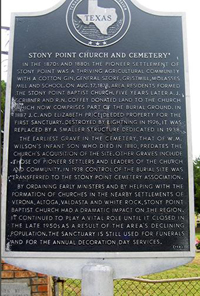
Front view of historical marker
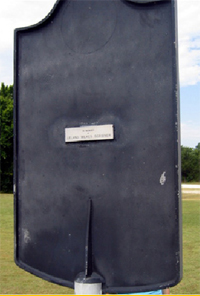
Back view of marker: In Memory
of Leland Wilkes Scribner
Dedication of Historical Marker
for Stoney Point Church and Cemetery
Dedication of the Historical Marker for Stoney Point Church and Cemetery will be held Decoration Day, April 30. The families will gather early and decorate the graves at Brinlee and Stoney Point Cemeteries. Then, at 11 a.m., a dedication service was conducted by the Rev. Clyde Moore, President of the Cemetery Associations.
C. D. Reedy Jr., chairman of the Collin County Historical Commission will speak on the duties and purpose of the Historical Commission in the county. At the unveiling, he will also read the legend on the face of the marker.
Decoration Day is a custom that has been observed sine 1913, when the church, "sitting in the conference," voted to observe Decoration Day on the last Saturday before the first Sunday in May. Stoney Point Baptist Church of Christ was organized Aug. 17, 1878 by the following: William Lovelady, A. K. Lovelady, J. H. Vermillion, M. J. Vermillion, S. A. Coffey, Willie A. Vance, William L. Nelson, J. E. Nelson, and A. J. and Mary E. Scribner.
The charter members (ones who joined the church the year following the organization) were: Nancy J. Davis, Zora Nichols and Elizabeth Price. During the following years, the enrollment increased and at the end of 1891 there were about 58 members.
The first land deeded to the church and cemetery was in January 1883. About the time the church was organized, Stony Point was a thriving community. It consisted of a general store, molasses mill, grist mill, the church and cemetery, and also as school. As late as 1926, this community was referred to as Chambliss: however, at this time Stoney Point is used, especially when referring to the cemetery. The original church building was destroyed by fire in 1926 and was rebuilt soon after. It was dedicated in 1928 after the final payment was made to the Wilcox Lumber Co.
In the later part of the 1950s, the membership declined. The people of the community moved to other towns seeking employment and better schools. At this time, regular services are no longer held at the church.
From Section II, McKinney Courier- Gazette, Sunday, April 24, 1983
Texas State Historical Marker
In the 1970s and 1980s, Cemetery Association officers Leland Wilkes Scribner and Jewell Thompson Mitchell were instrumental in securing the state historical marker. After Leland Wilkes Scribner's death in 1981, Jewell Mitchell continued the project. Donations made in the name of Leland Wilkes Scribner (former association president) were used to defray the cost of installation of the marker. His name is inscribed on the back of the marker. The text on the marker reads:
On Aug. 17, 1878, area residents formed the Stony Point Baptist Church. Five years later A. J. Scribner and R. N. Coffey donated land to the church, which now comprises part of the burial ground. In 1887, J. C. and Elizabeth Price deeded property for the first sanctuary. Destroyed by lightning in 1926, it was replaced by a smaller structure dedicated in 1938.
The earliest grave in the cemetery, that of W. M. Wilson's infant son who died in 1880, predates the Church's acquisition of the site. Other graves include those of pioneer settlers and leaders of the church and community.
In 1938 control of the burial site was transferred to the Stony Point Cemetery Association. By ordaining early ministers and by helping with the formation of churches in the nearby settlements of Verona, Altoga, Valdasta and White Rock, the Stony Point Baptist Church had a dramatic impact of the region. It continued to play a vital role until it closed in the late 1950s as a result of the area's declining population. The sanctuary is still used for funerals and for the annual Decoration Day services.